The new generation European Multi-Mission Frigates (FFGH), commissioned from Fincantieri and built as part of an international cooperation with France, today represent the backbone of the surface naval component of the Navy. These naval units have in fact progressively replaced the 4 "Lupo" class frigates and the 4 "Soldati" class (already decommissioned), as well as the 8 "Maestrale" class frigates, of which only two are still operational.
The program, managed by OCCAR (Joint Organization for Armament Cooperation), provides for the acquisition of a total of 10 multi-mission frigates: 4 in the "General Purpose" (GP) configuration, characterized by high flexibility of use, and 6 in the anti-submarine version (ASW), optimized for subsurface warfare.
In 2020, the last two FREMMs initially intended for the Navy were acquired by the Egyptian Navy. Delivered between December 2020 and April 2021, they entered service as Al-Galala (FFG-1002, ex Spartaco Schergat - F 598) and Bernees (FFG-1003, ex Emilio Bianchi - F 589).
Following this sale, the national industry immediately restarted the construction program of the last two FREMMs destined for the Navy. A third version of equipment has been developed for these units, called FREMM ASW-E (Anti Submarine Warfare – Enhanced), aimed at further enhancing the operational capabilities of previous versions.
The Schergat and Bianchi ships will therefore be equipped with combined systems typical of both the GP version, configured to offer a balanced contribution in all forms of fighting, and the ASW version, with marked anti-submarine capabilities, ideal for sea-control operations, protection of maritime communication lines and naval interdiction.Nave Bianchi is the tenth European Multi-Mission Frigate (FREMM) of the Bergamini Class and the second, after its sister unit Spartaco Schergat, in Anti Submarine Warfare-Enhanced configuration, which combines the peculiarities of a FREMM "General Purpose" with the strong submarine fighting capabilities typical of the FREMM "ASW".
Designed and built entirely in Italy, the unit is optimized in a multi-role version that combines the ability to provide a balanced contribution in all forms of combat to the strong anti-submarine capabilities for sea control operations, to protect maritime lines of communication and naval interdiction. In addition, the Unit will be able to operate in joint/combined contexts.
The operational requirements developed for this class of Units are state-of-the-art, designed to guarantee a wide spectrum of capabilities and missions. The FREMM are designed to deal with diversified operational uses, with continuous long-term deployments of up to 6 months, and with a crew reduced by about half compared to the frigates of the previous generation.
To meet these needs, a marked automation of the on-board systems has been adopted, with the latest generation systems that affect the entire set of ship services. High operational availability is also guaranteed by an optimized maintenance profile, which allows greater autonomy and an adequate logistical standard to face prolonged missions, even outside the enlarged Mediterranean basin.
These characteristics, innovative compared to the previous platforms of the Cavour and Orizzonte classes, required a significant commitment in terms of design, organization and management. In particular, an in-depth study of Human Factors was conducted, never before experienced at such a level of detail, made possible by a close collaboration between the Navy and the national industry in the Defense sector.
The propulsion is of the CODLAG hybrid type (COmbined Diesel-electric And Gas turbine) and consists of a 32 MW gas turbine, two 2.15 MW reversible electric motors mounted on the axles, two variable pitch propellers, four diesel generators of 2.1 MW each and an electric motor with a retractable azimuth forward propeller (ART). This system allows for a variety of operational configurations, allowing the unit to reach speeds in excess of 27 knots and a range of 6,000 nautical miles at a cruising speed of 15 knots. All propulsion, power generation and control systems are managed by an integrated platform management system.
The combat system guarantees extended air defense capabilities thanks to the SAAM ESD (Extended Self Defence) suite, which employs ASTER 15 and ASTER 30 surface-to-air missiles, supported by an MFR-A multifunction radar with active modules (TRM - Transmit Receive Module).
Compared to the previous GP versions, the new FREMMs will be integrated with the underwater threat detection and countering systems typical of the ASW version. Of particular importance is the acoustic sensory suite, consisting of BMS hull sonar, TB variable depth sonar, TA towed passive hydrophonic curtain (CAPTAS 4) and anti-torpedo countermeasures launch system for ASW fighting.
The unit will also be equipped with modern anti-ship weapon systems, including TESEO MK2/A surface-to-surface missiles, and two 324 mm torpedo launchers for the use of the Eurotorp MU90 light anti-submarine torpedo. The artillery sector includes a 127/64 mm Light Weight system, capable of using both conventional ammunition and inertial/GPS guided projectiles of the Vulcano type, a 76/62 mm Super Rapid system with DAVIDE system for DART guided ammunition for anti-missile use, and two 25/80 mm Otomelara Oerlikon KBA machine guns.
The equipment is completed by the latest generation active and passive electronic warfare systems. The unit is designed to operate in full integration with EH-101 and NH-90 helicopters, significantly extending its range of action and the operational capabilities of the air-naval device in which it is inserted. Finally, there will be the capacity to embark two RHIB (Rigid Hull Inflatable Boats) with rigid keel, stowed amidships.
The location of assignment is La Spezia.
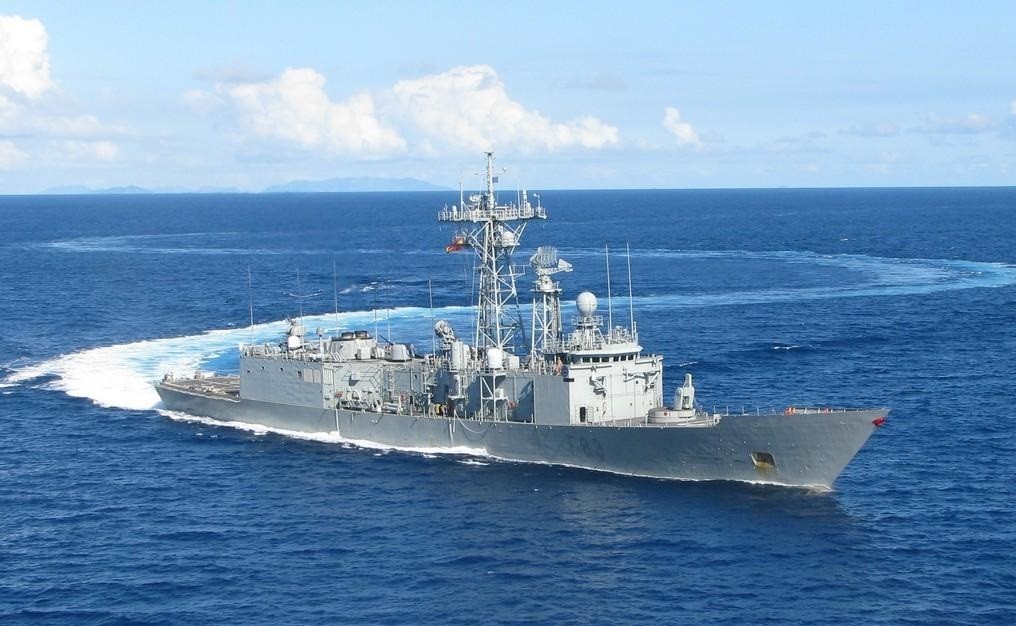
The Canarias is the sixth frigate of the Santa María class and the second of the second series, of which it is part together with the Navarra. With an original design very oriented to anti-submarine warfare, these ships have evolved to adapt to changing scenarios and are capable of performing a wide range of missions both conventional warfare and maritime security. Crewed by more than two hundred dedicated professionals, the Canary Islands protect Spaniards from the sea being faithful to its motto, to be "Always ready!".
The Frigate Canarias is the sixth and last frigate of the Santa María class (FFG) built by the national company Bazán on American design (Oliver Hazard Perry) with the incorporation of national teams to achieve its adaptation to the requirements of the Navy, and which was delivered in 1994.
Only one ship before it bore the name of 'Canarias' before this frigate, it was a 10,000-ton 'Washington' type cruiser that was the flagship of the Fleet for almost forty years until in December 1975 it was decommissioned from the Navy.
Initially, these ships were designed for eminently anti-submarine missions and for ocean escort operations, however, the changes experienced in the strategic environment have meant that the ships can be used in other tasks such as support in the projection of a naval force, maritime interdiction operations, integration in territorial air defense and surveillance and escort in different theaters of operations